Vocabulary
How vocabulary mastery works
Understand how Apilingual tracks the words you know, schedules reviews, and moves each word from recognition to recall to production.
New, learning, known
The first time you tap a word in the reader, Apilingual starts keeping track of it. Every word you meet carries a status, and there are only three worth thinking about: new, learning, and known. New is a word you haven’t dealt with yet. Learning is a word you’ve looked up, seen a few times, and are still pinning down. Known is a word that no longer slows you down when it appears.
Words don’t sit still. A new word you look up becomes learning. A learning word you keep meeting — and keep understanding without help — drifts toward known. And because the reader marks each word by its status right there in the text, you can watch your own comprehension thicken: a passage that was mostly unknowns in January reads mostly settled by spring.
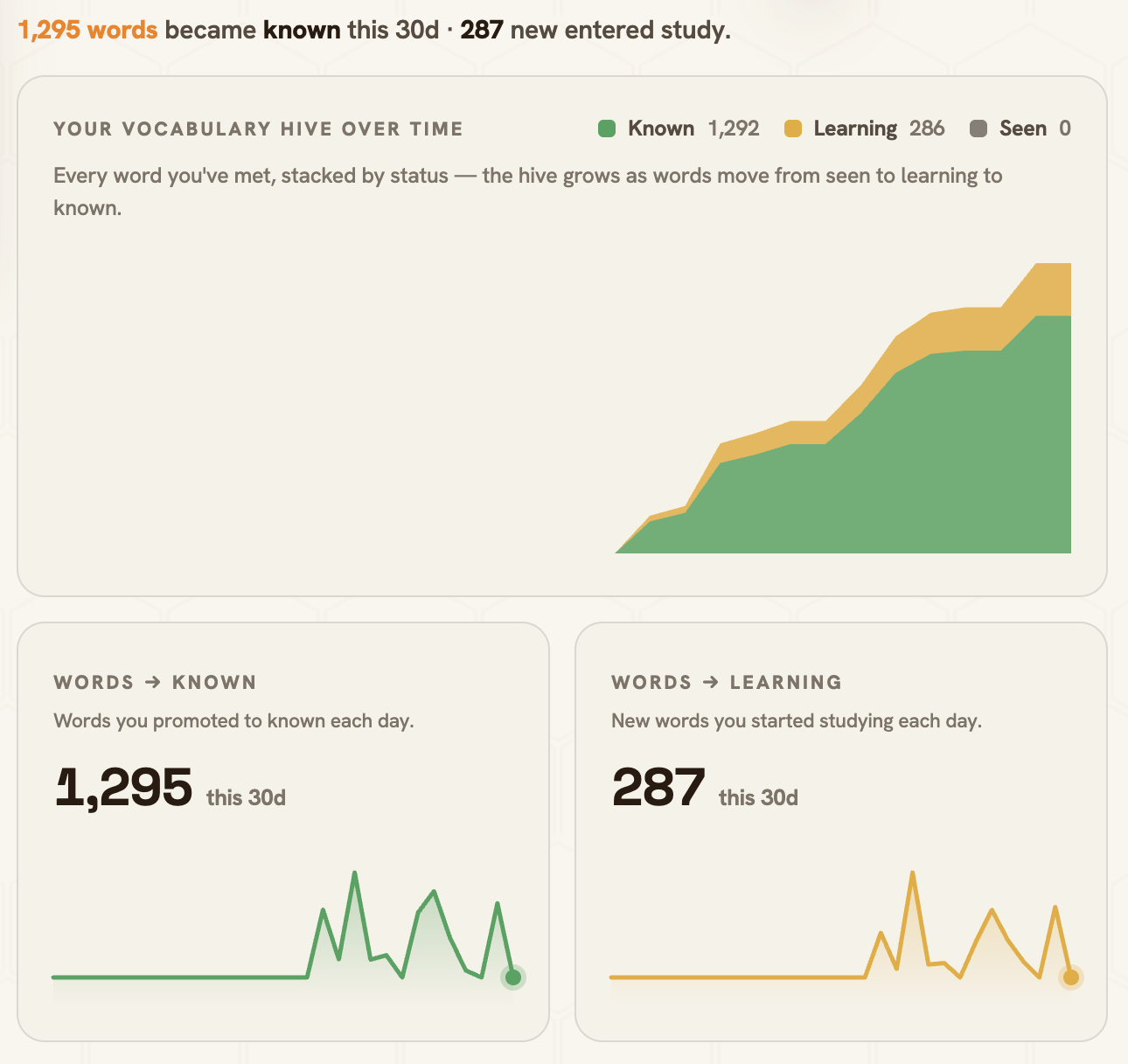
This is the ledger the rest of the system reads from. It’s also the honest part: the count doesn’t move because you opened the app, it moves because you understood more words than you did last week.
”Known” is hiding three different skills
Here’s the catch most vocabulary tools quietly ignore. “Known” isn’t one thing.
Think of a word in your target language you’d swear you know. There’s a good chance you can recognize it instantly when you read it, and still freeze when you try to recall it from a blank page — and freeze harder when you have to produce it correctly in a sentence of your own. Those are three different abilities, and they come apart all the time. Recognizing a word when it’s in front of you is the easiest. Pulling it out of memory on demand is harder. Producing it — right form, right context, unprompted — is hardest of all.
A word can be solidly “known” for reading and nearly useless for speaking. If a tool only ever tests the easy end, it will happily tell you a word is mastered while the language stays locked in your head. That gap is exactly where intermediate learners stall: a large passive vocabulary, a thin active one.
Recognition, recall, production — three skills, one score
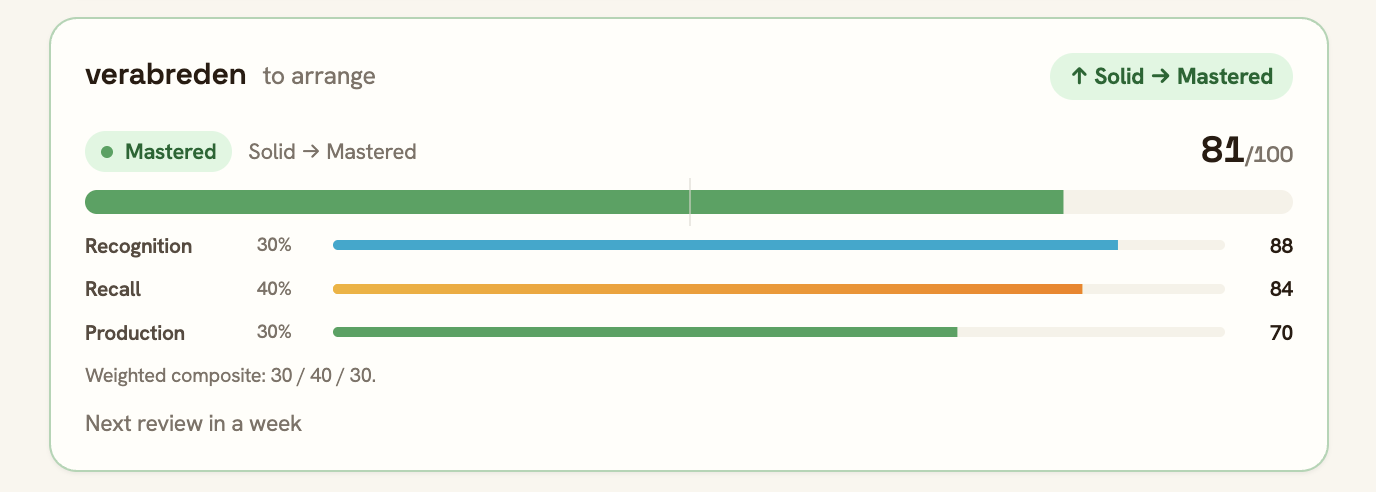
So Apilingual doesn’t give a word a single known-or-not flag. It gives it a mastery score from 0 to 100, built from how you actually perform on three separate fronts:
- Recognition — you see the word and know what it means.
- Recall — you’re given the meaning and produce the word.
- Production — you use the word yourself, in the right form, in context.
Each is earned its own way, through the kind of practice that genuinely exercises it — recognition through reading and quick prompts, recall through retrieval, production through building the word into a sentence. The score leans a little harder on recall, the pivot skill between passively reading a word and actively using it: roughly, recall carries the most weight, with recognition and production weighted about equally on either side of it. The exact blend isn’t the point. The point is that no single skill can carry the whole score — a word only climbs toward mastery as all three come up together.
Why you can’t grind the score
This is the part people either love or find inconvenient, depending on how other apps have trained them.
You cannot inflate a word’s mastery by hammering the easy button on reviews you already know cold. Recognizing a word you recognized yesterday, and the day before, adds almost nothing once recognition is already high — the score has stopped listening there. To move it, you have to demonstrate the skill that’s actually lagging: recall the word you can only recognize, produce the word you can only recall.
That’s deliberate. A number you can grind is a number that lies to you. The whole reason to have a mastery score is so it means something when it climbs — so that an 80 is a promise about what you can do with the word, not a tally of how many times you tapped it. Mastery here is earned by performance, not by showing up. It’s less flattering than a streak. It’s also the only version worth trusting.
Reviews that arrive just before you’d forget
Memory fades on a curve. A word you learn today is sharp tomorrow, softer next week, gone in a month if nothing touches it — and the curve is different for every word and every person. The trick to remembering efficiently is to review a word right at the edge of forgetting: too early and you waste a repetition on something still fresh; too late and you’ve lost it and have to relearn from scratch.
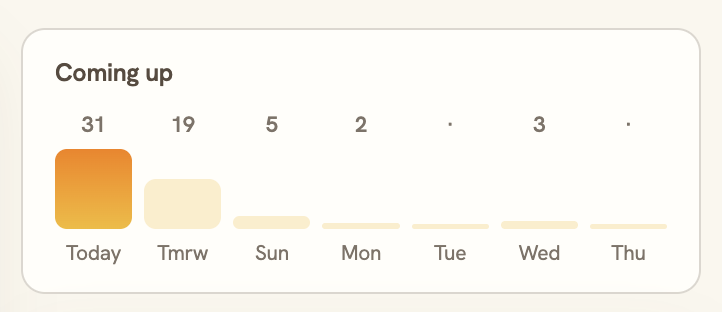
Apilingual schedules your reviews against that edge. Instead of marching every word past you on a fixed daily calendar, it predicts when each word is about to slip and surfaces it then. A word you find genuinely hard comes back soon and often. A word you’ve made yours stretches out to weeks, then months, fading quietly into the background so your practice time lands where it’s needed. Under the hood this runs on a modern forgetting-curve model (FSRS, if you like acronyms); in practice it just means reviews arrive when they’ll do the most good, and you never grind through a stack of words you already own.
Reading is practice, too
None of this lives in a separate quiz app bolted onto your reading. The reader and the review queue are the same system.
Every time you meet a word in a real passage and understand it, that counts — it registers as a successful recognition, and it feeds the word’s schedule and status just like a formal review does. Read enough and some words graduate to known on encounters alone, without ever needing a drill. Formal practice is there to work the skills reading can’t reach on its own — recall and production, the active side — and to catch the words you’re quietly losing. But the foundation is the reading itself. The more real content you get through, the more your review queue takes care of itself, and the more your vocabulary grows into something you can use, not just something you’ve met.